

Heart rate zones for HYROX preparation
Understand how to train using heart rate zones to optimize your HYROX prep.
Sync Your Sweat: Mastering HYROX Preparation with Heart Rate Zones
HYROX, the ultimate functional fitness race, demands a unique blend of strength, endurance, and mental fortitude. To conquer its demanding combination of eight 1km runs and eight functional exercises, a strategic approach to training is paramount. One of the most effective yet often underutilized tools in the HYROX athlete's arsenal is understanding and applying heart rate zones. This scientific approach allows you to train smarter, boost efficiency, and ensure you're developing the specific physiological adaptations required to excel.
For intermediate athletes aged 20-55, mastering these zones can be the difference between merely finishing and truly performing. Forget blindly pushing yourself to the limit every session; intelligent training means dialing into your body's signals.
Decoding Your Heart: The Science of Heart Rate Zones
Your heart rate is a direct indicator of your cardiovascular system's workload. Heart rate zones, typically categorized into five distinct levels, represent different intensities of exercise and elicit specific physiological responses. These zones are usually calculated as a percentage of your Maximum Heart Rate (MHR) or Heart Rate Reserve (HRR).
Calculating Your Zones:
- Maximum Heart Rate (MHR): The most common and straightforward method is the "220 minus your age" formula. While a good starting point, it's an estimation and can vary significantly between individuals.
- Heart Rate Reserve (HRR): This method is considered more accurate as it accounts for your resting heart rate.
- HRR = MHR - Resting Heart Rate (RHR)
- Then, you calculate your target heart rate for each zone using:
- Target Heart Rate = (HRR x %Intensity) + RHR
Understanding the Zones and Their HYROX Relevance:
Let's break down each zone and its crucial role in your HYROX preparation:
Zone 1: Very Light (50-60% of MHR)
- Physiological Response: Minimal stress on the cardiovascular system. Primarily aids in active recovery and promotes blood flow.
- HYROX Relevance: This zone is your ally for active recovery days. After intense HYROX-specific workouts or heavy lifting sessions, Zone 1 activity can help clear metabolic waste products, reduce muscle soreness, and prepare your body for the next training block. Think of it as "cleaning up" from your harder efforts. It's also a great starting point for beginners gradually increasing their activity levels.
Zone 2: Light (60-70% of MHR)
- Physiological Response: Builds aerobic base, improves cardiovascular efficiency, and enhances fat utilization as a primary fuel source. You can hold a conversation easily in this zone.
- HYROX Relevance: This is the bread and butter of your aerobic base building. For HYROX, which involves significant running volume and sustained effort during exercises, a strong aerobic engine is non-negotiable. Spending ample time in Zone 2 improves your body's ability to deliver oxygen to working muscles and efficiently burn fat for energy, delaying fatigue during longer efforts. This zone is crucial for the 1km runs between exercises and the sustained effort required during many of the functional movements.
Zone 3: Moderate (70-80% of MHR)
- Physiological Response: Improves your lactate threshold, meaning your body becomes more efficient at clearing lactate, the byproduct of intense exercise. You can speak in short sentences. This is where you start building muscular endurance.
- HYROX Relevance: This zone is critical for developing the sustained power and endurance needed for the functional exercises. Think sled pushes, sandbag lunges, and burpee broad jumps. Training in Zone 3 enhances your ability to perform these movements at a higher intensity for longer durations without significant performance degradation. It also improves your pace during the running segments when you’re aiming for a more competitive time.
Zone 4: Hard (80-90% of MHR)
- Physiological Response: Pushes your VO2 max (maximum oxygen uptake), improves anaerobic capacity, and significantly increases your lactate threshold. You can only speak a few words at a time.
- HYROX Relevance: This is where you cultivate the explosive power and high-intensity capacity required for critical race moments. Think of the final sprint on a run segment, a particularly challenging lift, or pushing through the last few reps of a demanding exercise when fatigue is high. Incorporating Zone 4 work helps your body adapt to producing energy anaerobically and recovering faster from these bursts of effort, crucial for navigating the final stages of a HYROX race.
Zone 5: Maximum (90-100% of MHR)
- Physiological Response: Maximal effort, short duration. Primarily anaerobic. This is an all-out sprint.
- HYROX Relevance: While HYROX isn't a pure sprint race, there are short, high-intensity bursts where you'll hit these levels momentarily. This could be the initial surge of a sled push, a powerful deadlift, or a desperate final push to the finish line. While you won't spend extended periods here, developing your ability to momentarily access Zone 5 can provide a competitive edge. However, for intermediate athletes, over-reliance on this zone can lead to excessive fatigue and hinder overall progress.
Practical Application: Integrating Heart Rate Zones into Your HYROX Training
Now, let's translate this science into actionable training strategies:
1. Establish Your Baseline:
- Determine your MHR: Use the 220-age formula as a starting point, but consider a field test if you feel it's inaccurate. A common field test involves a graded exercise test on a treadmill or bike, gradually increasing intensity until exhaustion.
- Calculate your zones: Once you have your MHR (and ideally your RHR), calculate your target heart rate ranges for each zone using the HRR method.
2. Structure Your HYROX Training Plan:
Your HYROX training should be a carefully balanced mix of work and recovery, with different zones playing specific roles:
- Aerobic Base Building (Zone 2 Focus): Dedicate a significant portion of your training to longer, steady-state runs and cardio sessions in Zone 2. This builds the foundational endurance needed for the entire race. Aim for 2-3 sessions per week, gradually increasing duration.
- Functional Strength & Endurance (Zone 3 Focus): Incorporate HYROX-specific workout simulations or exercises that mimic race demands. This could be:
- Performing sets of sled pushes or pulls with slightly lighter weight, focusing on maintaining a consistent effort that keeps your heart rate in Zone 3.
- Circuit training incorporating exercises like burpees, kettlebell swings, and lunges, aiming for controlled intensity.
- Interval training on a treadmill or bike with longer work intervals in Zone 3.
- High-Intensity Intervals (Zone 4 Focus): Introduce shorter, more intense intervals to improve your VO2 max and anaerobic capacity. Examples include:
- "On/off" intervals: 1-2 minutes of hard work (Zone 4) followed by equal or slightly longer recovery (Zone 2 or 1).
- Shorter, more explosive functional movements with active recovery.
- Hill sprints.
- Active Recovery (Zone 1 Focus): Schedule dedicated active recovery days. This could be a light walk, easy cycling, or swimming. The key is to keep your heart rate low and promote blood flow without adding significant stress.
- Race Simulation: As you get closer to your HYROX event, incorporate more race-specific simulations that blend running segments with functional exercises. Pay attention to your heart rate throughout these simulations to identify areas where you might be overexerting or not pushing hard enough. Aim to keep your heart rate within appropriate zones for each segment.
3. Practical Tips for Tracking and Implementation:
- Invest in a reliable heart rate monitor: A chest strap monitor generally provides more accurate readings than wrist-based trackers, especially during high-intensity exercise.
- Listen to your body: While heart rate zones are a scientific guide, they are not the only indicator. Pay attention to how you feel. If your heart rate is in Zone 2 but you feel completely spent, dial it back. Conversely, if your heart rate is lower than expected, you might be able to push a little harder.
- Gradual Progression: Don't jump into high-intensity zones without proper preparation. Gradually increase the duration and intensity of your Zone 2 and Zone 3 training before introducing Zone 4 work.
- Periodization: Integrate different training phases. Focus on building your aerobic base (Zone 2) in the early stages, then gradually introduce more Zone 3 and Zone 4 work as your race date approaches.
- Monitor and Adjust: Your fitness level will change. Re-assess your MHR and zones periodically (e.g., every 6-8 weeks) to ensure your training remains effective.
The HYROX Advantage: Why Heart Rate Zones Matter
By consciously training within specific heart rate zones, you are:
- Boosting Efficiency: You're directing your physiological efforts towards the most beneficial adaptations for HYROX. No wasted energy on under-training or over-training.
- Optimizing Performance: You're building the specific endurance and power required for the race's unique demands.
- Reducing Injury Risk: By avoiding constant high-intensity efforts and incorporating adequate recovery, you minimize the risk of overtraining and burnout.
- Improving Race Strategy: Understanding your zones allows you to pace yourself more effectively during the race, ensuring you have enough fuel for the entire event.
Mastering heart rate zones for HYROX preparation is about more than just numbers; it's about understanding your body's intricate systems and directing your training with precision. By syncing your sweat with the science of heart rate zones, intermediate athletes can unlock their true potential and conquer the demanding challenge of HYROX. Train smart, train with intent, and race strong.
Related Articles
How to train for hybrid running events
Tips to mix running and strength effectively for HYROX and other hybrid events.
Should you run outside or on a treadmill?
Pros and cons of treadmill vs outdoor running when training for HYROX.
Running strategy between HYROX stations
Learn how to pace your 1Ks to stay strong across the full HYROX course.
Ready for a structured plan?
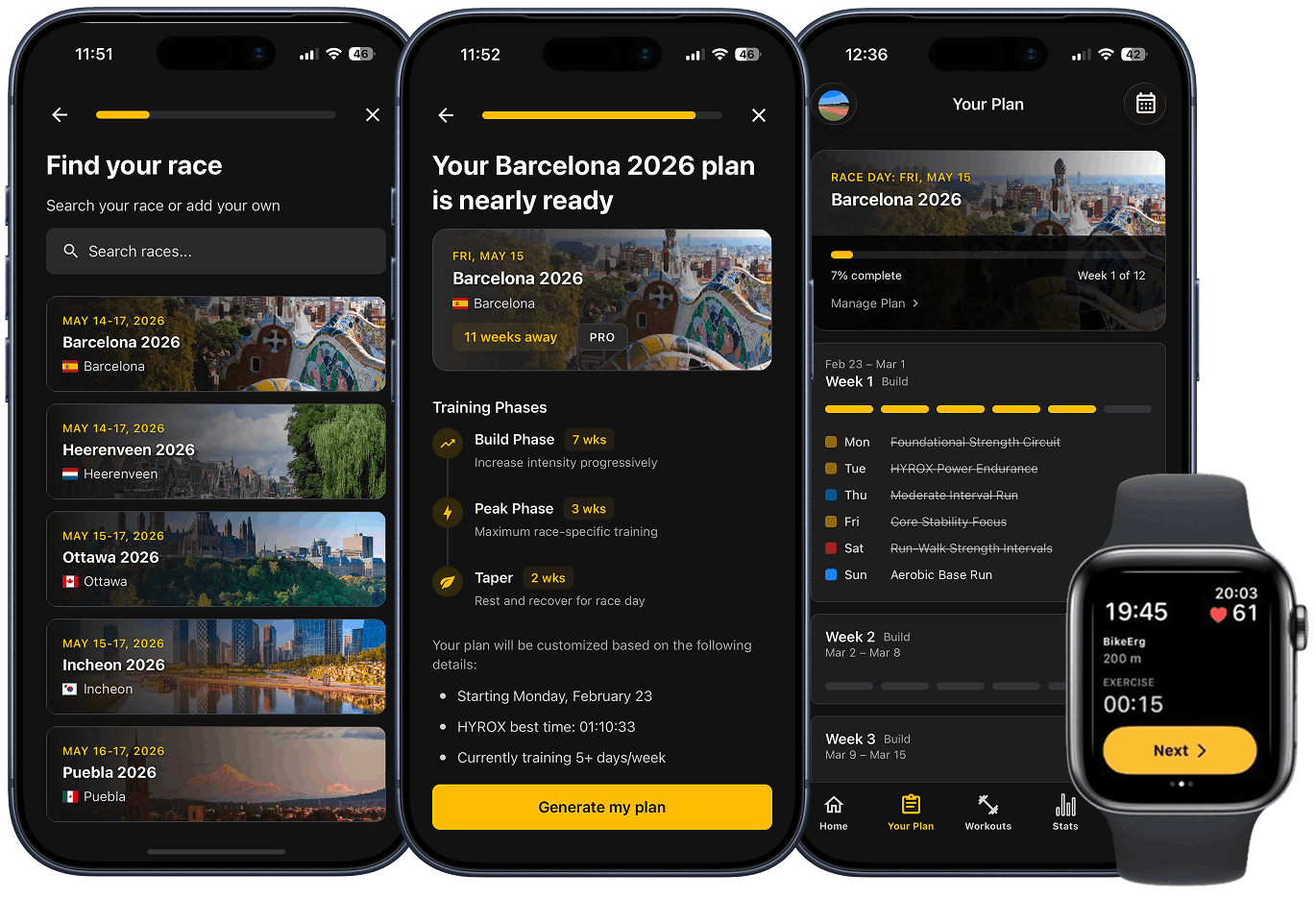
Stop guessing what to do next. TrainRox builds personalized HYROX and hybrid fitness training plans based on your fitness level and race goals.
Get daily workouts, track your progress, and arrive at the start line knowing you've done the right work.


First week free. Cancel anytime.