

HYROX vs CrossFit vs Spartan Race: What’s the difference?
A side-by-side breakdown of HYROX, CrossFit, and Spartan Races, how they compare in structure, difficulty, and goals.
HYROX vs. CrossFit vs. Spartan Race: Navigating the World of Functional Fitness and Obstacle Challenges
The fitness landscape is booming with diverse challenges designed to push our physical and mental limits. For those seeking more than just a traditional gym routine, events like HYROX, CrossFit, and Spartan Race have emerged as popular destinations. While all three promise to test your mettle, they offer distinct experiences, catering to different strengths, training philosophies, and ultimate goals. Understanding these differences is crucial for anyone looking to choose the right challenge to conquer.
Let's dive into a comprehensive side-by-side comparison of HYROX, CrossFit, and Spartan Race, exploring their structure, difficulty, and the unique qualities that set them apart.
HYROX: The Ultimate Functional Fitness Competition
What it is: HYROX bills itself as "the world’s leading fitness competition." It’s a standardized, global event that combines a consistent running format with a series of functional fitness exercises. Think of it as a race against yourself and hundreds of others in a controlled, competitive environment.
The Structure: Every HYROX event follows the same template:
- 8 x 1km Runs: Athletes complete eight one-kilometer runs throughout the course.
- 8 Functional Workouts: Between each run, participants tackle a specific functional fitness workout. These workouts are designed to be accessible to a wide range of fitness levels but still demanding.
The workouts are:
- Ski Erg: A test of upper body and core strength, simulating skiing.
- Sled Push: A brutal test of lower body strength and endurance, pushing a weighted sled over a set distance.
- Sled Pull: Similar to the push, but pulling a weighted sled using a rope.
- Burpee Broad Jumps: A full-body explosive movement testing power and coordination.
- Rowing: Another cardiovascular challenge, replicating the motion of rowing.
- Farmer's Carry: Holding heavy dumbbells in each hand and walking a set distance, challenging grip strength and core stability.
- Sandbag Lunges: Performing walking lunges with a weighted sandbag, testing lower body strength and endurance.
- Wall Balls: Throwing a medicine ball against a wall, requiring squatting power, core engagement, and upper body explosiveness.
Difficulty & Goals: HYROX is designed for broad appeal. While the workouts are challenging, they are generally standardized with moderate weights and distances, allowing individuals of varying skill sets to participate. The difficulty lies in the cumulative fatigue. Running 8 kilometers interspersed with demanding functional movements requires a well-rounded fitness base encompassing cardiovascular endurance, strength, power, and muscular endurance.
Who it's for:
- Individuals who enjoy a structured, predictable competition.
- Those who have a solid foundation in functional fitness and enjoy diverse movements.
- Athletes looking for a quantifiable measure of their fitness progress across multiple domains.
- People who thrive in a supportive yet competitive environment.
Practical Tips for HYROX:
- Train for the specific workouts: Don't just run; practice each HYROX movement with the prescribed weights and distances.
- Focus on pacing: Learn to conserve energy during the runs so you have enough in the tank for the workouts.
- Master transitions: Minimize your time between the run and the workout to maximize your overall performance.
- Grip strength is key: The Farmer's Carry and Sled Pull will test your grip. Incorporate grip-strengthening exercises into your routine.
CrossFit: The "Constantly Varied, High-Intensity Functional Movement"
What it is: CrossFit is a branded fitness regimen that emphasizes constantly varied functional movements performed at high intensity. It's a training methodology that typically takes place in affiliated gyms (boxes) and culminates in a competitive atmosphere, often with local competitions or the ultimate goal of the CrossFit Games.
The Structure: CrossFit workouts, known as "Workouts of the Day" (WODs), are incredibly diverse. They can include:
- Weightlifting: Olympic lifts like the snatch and clean & jerk, and powerlifting movements such as squats, deadlifts, and bench presses.
- Gymnastics: Bodyweight movements like pull-ups, push-ups, handstands, and muscle-ups.
- Monostructural Metabolic Conditioning: Cardiovascular exercises like running, rowing, cycling, and jump rope.
WODs can vary in length, intensity, and focus. Some might be short, explosive bursts (AMRAP – As Many Rounds/Reps As Possible), others might be time-based (For Time), and some might be designed for endurance. The beauty and challenge of CrossFit lie in its unpredictability.
Difficulty & Goals: CrossFit is known for its high intensity and demanding nature. The difficulty can range significantly depending on the specific WOD and the athlete's skill level. The goal of CrossFit training is to build broad, general, and inclusive fitness across ten recognized physical skills: Cardiovascular/Respiratory Endurance, Stamina, Strength, Flexibility, Power, Speed, Coordination, Agility, Balance, and Accuracy. Many participants aim to improve their performance in these skills, compete in local or larger CrossFit events, or simply achieve a higher level of overall physical preparedness.
Who it's for:
- Individuals who thrive on variety and hate boredom in their workouts.
- Those who enjoy lifting weights and performing complex movements.
- People seeking to improve a wide range of physical attributes.
- Athletes who are comfortable with pushing their limits and embracing a high-intensity training style.
- Individuals looking for a strong community aspect in their fitness journey.
Practical Tips for CrossFit:
- Prioritize proper form: Especially with Olympic lifts, good technique is paramount to prevent injury and maximize efficiency.
- Listen to your body: CrossFit is intense. Don't be afraid to scale movements or take rest days when needed.
- Build a broad fitness base: Don't neglect cardiovascular endurance or flexibility in favor of just lifting heavy.
- Embrace the learning curve: There's always something new to learn in CrossFit, from new movements to strategies for specific WODs.
Spartan Race: The Ultimate Obstacle Course Race (OCR)
What it is: Spartan Race is a global leader in obstacle course racing, offering a series of events designed to test your physical and mental resilience against a variety of challenging obstacles. It’s about more than just running; it’s about overcoming environmental barriers.
The Structure: Spartan Race offers several different race distances and difficulties:
- Spartan Sprint: Typically 3+ miles with 20+ obstacles.
- Super Spartan: Typically 8+ miles with 25+ obstacles.
- Spartan Beast: Typically 13+ miles with 30+ obstacles.
- Spartan Ultra: The longest and most demanding, often 25+ miles with 60+ obstacles.
Obstacles can include:
- Walls: Climbing over various heights of walls.
- Barbed Wire Crawls: Low crawling under barbed wire.
- Spear Throw: Throwing a spear at a target.
- Hercules Hoist: Lifting a heavy weight with a rope and pulley system.
- Atlas Carry: Carrying a heavy concrete ball.
- Tire Flips: Flipping oversized tires.
- Multi-Rig: Traversing monkey bars and other suspended elements.
Failure to complete an obstacle typically results in a penalty, often 30 burpees, which adds a significant cardiovascular and muscular endurance challenge.
Difficulty & Goals: Spartan Race is inherently challenging due to the combination of running and the demanding nature of the obstacles. The difficulty scales with the race distance and the complexity of the obstacles. The primary goal is to finish the race, demonstrating grit, determination, and the ability to overcome physical and mental adversity. Many participants aim to improve their race times, qualify for championship events, or simply complete a more challenging distance than before.
Who it's for:
- Individuals who enjoy outdoor adventures and a challenge in natural environments.
- Those who are good at problem-solving and adapting to new physical challenges.
- People who want to build mental toughness and push through discomfort.
- Athletes who have a strong running base and enjoy incorporating strength and agility into their training.
Practical Tips for Spartan Race:
- Practice burpees: Seriously, practice them. You'll likely do them, and doing them efficiently is crucial.
- Build grip strength and upper body pulling strength: Many obstacles will test these.
- Train for varied terrain: If possible, train on hills and uneven surfaces.
- Learn obstacle techniques: Watch videos and practice common Spartan obstacles.
- Hydrate and fuel properly: For longer races, nutrition and hydration are critical.
HYROX vs. CrossFit vs. Spartan Race: A Comparative Overview
| Feature | HYROX | CrossFit | Spartan Race |
|---|---|---|---|
| Format | Standardized run/workout combination | Constantly varied WODs (gym-based) | Obstacle course race (outdoor, varied terrain) |
| Structure | 8 x 1km runs + 8 functional workouts | Diverse WODs, varying intensity & focus | Running with 20-60+ obstacles (depending on race) |
| Key Skills | Cardiovascular endurance, functional strength, muscular endurance | Broad fitness: strength, cardio, gymnastics, power, flexibility | Running endurance, grip strength, upper body strength, agility, mental toughness |
| Predictability | High (same format globally) | Low (WODs vary daily) | Moderate (obstacles vary by race, but general types are consistent) |
| Environment | Indoor arena | Gym (Box) | Outdoor (trails, mud, varied terrain) |
| Primary Goal | Quantifiable fitness across domains | Overall fitness development, competition | Overcoming obstacles, mental resilience |
| Competition Level | Global, standardized | Local, regional, national (CrossFit Games) | Global, tiered by distance/difficulty |
Choosing Your Challenge: What's Right for You?
Deciding which event aligns best with your fitness goals and preferences requires introspection:
- If you crave structure and predictable challenges: HYROX might be your ideal starting point. Its standardized format allows for focused training and clear performance benchmarks.
- If you love variety, weightlifting, and gymnastics: CrossFit offers an ever-changing landscape of physical demands, catering to those who thrive on skill development and high-intensity training.
- If you're an outdoor enthusiast who enjoys overcoming physical barriers and building mental grit: Spartan Race provides an adventurous and demanding challenge that tests your resilience in natural environments.
Ultimately, all three offer incredible opportunities for personal growth and physical achievement. Consider your current fitness level, what aspects of fitness you enjoy most, and what kind of experience you're seeking. Don't be afraid to try one and then explore another. The journey of challenging yourself is often the most rewarding part.
Related Articles
How to combine HYROX with other sports or goals
Tips to combine HYROX with triathlon, marathon, CrossFit, or general training goals.
HYROX vs DEKA: Which hybrid race is for you?
Explore the similarities and differences between HYROX and DEKA events.
How the HYROX race is structured (event by event)
A breakdown of the full HYROX sequence, explaining each station and run in order.
Ready for a structured plan?
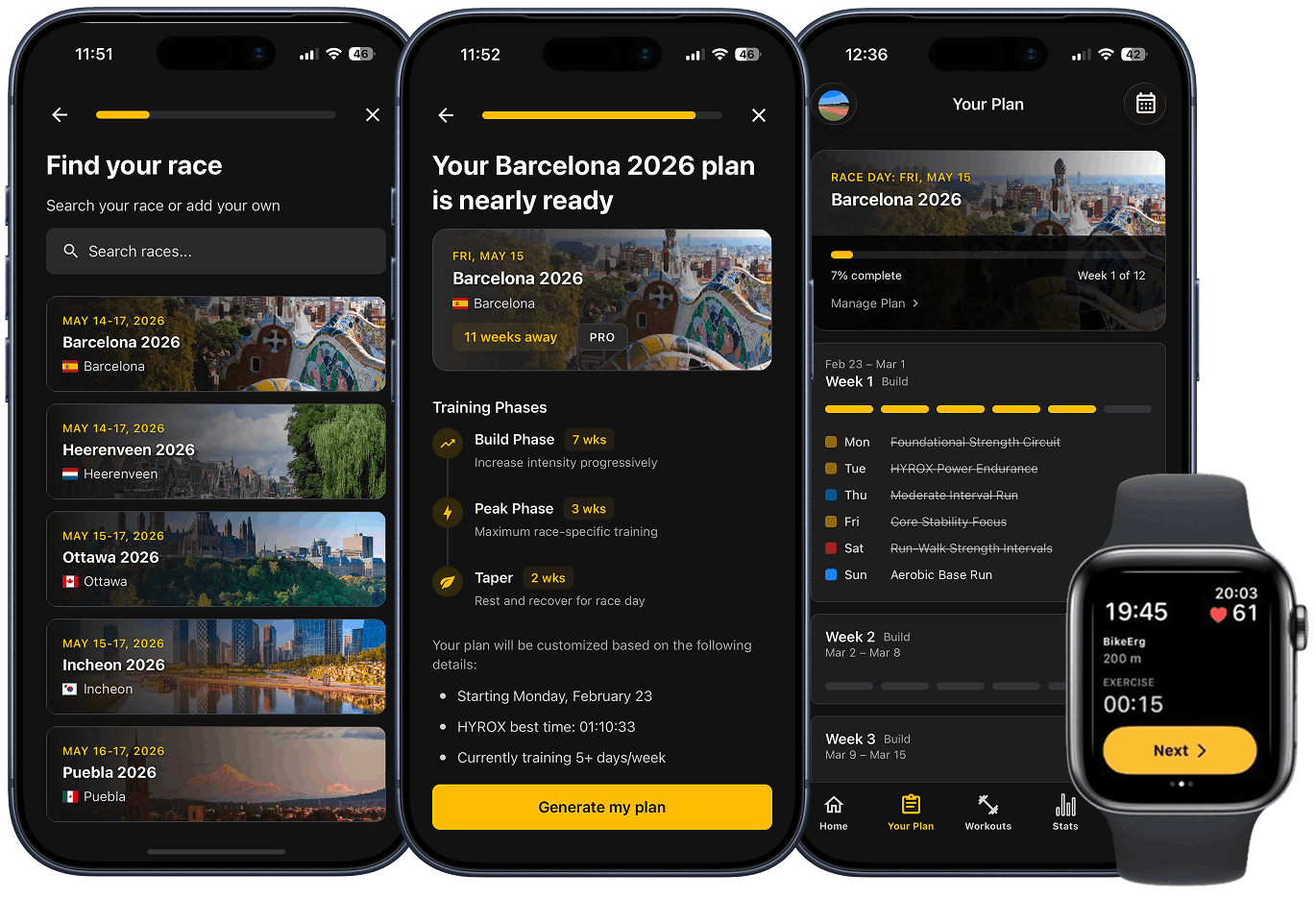
Stop guessing what to do next. TrainRox builds personalized HYROX and hybrid fitness training plans based on your fitness level and race goals.
Get daily workouts, track your progress, and arrive at the start line knowing you've done the right work.


First week free. Cancel anytime.