

How to build your own HYROX-style circuit workout
Build your own HYROX-inspired circuit to train anywhere.
Unleash Your Inner HYROX: Craft Your Own Circuit and Conquer the Competition
The roar of the crowd, the rhythmic thud of footsteps, the satisfying burn in your muscles – you’ve seen it, you’ve heard about it, and you’ve likely felt the magnetic pull of HYROX. This unique fitness competition, blending strength and endurance through a series of functional workouts interspersed with running, has taken the fitness world by storm. But what if you don’t have a HYROX event on your doorstep, or your budget doesn’t stretch to the entry fee? Don’t despair! You can harness the power of HYROX and build your own inspired circuit, tailored to your environment and available equipment.
This isn't about replicating HYROX perfectly; it’s about capturing its essence. It’s about challenging yourself across multiple disciplines, pushing your physical and mental boundaries, and discovering a new level of fitness. So, grab your water bottle, clear some space, and let’s build a HYROX-style circuit that will leave you breathless, accomplished, and ready to conquer anything.
The HYROX Philosophy: Why It Works
Before we dive into the “how,” let’s understand the “why” behind HYROX’s success. It’s a masterful blend of:
- Functional Movements: Exercises that mimic everyday actions, building real-world strength and resilience. Think pushing, pulling, lifting, carrying, and squatting.
- Cardiovascular Endurance: Sustained effort that challenges your heart and lungs, improving your stamina and ability to recover.
- Muscular Endurance: The ability of your muscles to perform repeated contractions over a sustained period. This is where the real burn comes in.
- Mental Fortitude: Pushing through fatigue, staying focused, and maintaining composure under pressure.
By creating your own circuit, you’re not just getting a workout; you’re engaging in a holistic training approach.
Deconstructing HYROX: Identifying Your Building Blocks
The official HYROX race consists of 8km of running interspersed with 8 functional workout stations. Each station targets different muscle groups and energy systems. Our mission is to find equivalent, accessible exercises that hit those same key areas.
Let’s break down the official HYROX stations and brainstorm our homemade alternatives:
Ski Erg: This is a fantastic full-body cardio and strength movement.
- Your Circuit Equivalent:
- Bodyweight: Burpee Broad Jumps: A high-intensity, full-body movement that mimics the explosive power of the ski erg.
- With Equipment: Resistance Band Pull-Aparts: Hold a resistance band with a wide grip and pull it apart, engaging your upper back and shoulders. You can also do Dumbbell Rows (per arm) or TRX Rows for a similar pulling motion.
- Your Circuit Equivalent:
Sled Push: A true test of lower body strength and grit.
- Your Circuit Equivalent:
- Bodyweight: Bear Crawls: A challenging full-body movement that engages your core and shoulders, with a significant lower body drive.
- With Equipment: Household Object Push: Use a weighted object like a sturdy laundry basket filled with books, a heavy suitcase, or even a weighted furniture slider. Find a smooth surface (hardwood floor, gym floor) and push it as far as you can. Alternatively, Lunges with a Weight (dumbbells, kettlebell, or even a backpack) can simulate the leg engagement.
- Your Circuit Equivalent:
Sled Pull: The inverse of the sled push, challenging your posterior chain.
- Your Circuit Equivalent:
- Bodyweight: Inchworms with Push-up: Starting from a standing position, walk your hands out to a plank, perform a push-up, and then walk your feet back towards your hands. This engages your core and shoulders.
- With Equipment: Resistance Band Pulls: Anchor a resistance band to a sturdy object and pull it towards you, simulating the pulling motion. You can also use a Rope Pull (if you have access to one) or Kettlebell Swings (focusing on the hip hinge).
- Your Circuit Equivalent:
Burpee Broad Jumps: The ultimate test of explosive power and full-body coordination.
- Your Circuit Equivalent: This is already a functional movement, so you can keep it as is! If you want to vary it, consider Jumping Lunges or Squat Jumps with a Tuck.
Rowing (Concept2 Rower): A staple of endurance and full-body strength.
- Your Circuit Equivalent:
- Bodyweight: High Knees: A pure cardio blast that elevates your heart rate significantly.
- With Equipment: Jumping Jacks: A classic cardio mover. For a more strength-focused alternative, consider Bicep Curls followed by Overhead Presses with dumbbells or resistance bands, as rowing engages both upper and lower body.
- Your Circuit Equivalent:
Farmers Carry: Builds grip strength, core stability, and shoulder endurance.
- Your Circuit Equivalent:
- Bodyweight: Plank with Shoulder Taps: Holding a plank position, tap opposite shoulders, engaging your core and shoulder stability.
- With Equipment: Dumbbell/Kettlebell Farmer's Walk: Grab a heavy dumbbell or kettlebell in each hand and walk for a designated distance. If you only have one weight, alternate sides or do a Suitcase Carry (one weight on one side).
- Your Circuit Equivalent:
Sandbag Lunges: A gruelling test of leg strength, core stability, and endurance under load.
- Your Circuit Equivalent:
- Bodyweight: Walking Lunges: Focus on maintaining good form and control.
- With Equipment: Backpack Lunges: Fill a sturdy backpack with books or weights and wear it while performing lunges. You can also use Dumbbell Lunges or Kettlebell Goblet Lunges.
- Your Circuit Equivalent:
Wall Balls: A powerful combination of squatting, throwing, and catching, testing power and coordination.
- Your Circuit Equivalent:
- Bodyweight: Squat to Calf Raise: A simple yet effective movement to engage your quads and calves.
- With Equipment: Medicine Ball Slams: Slam a medicine ball onto the ground with power. If you don't have a medicine ball, you can mimic the motion with a weighted ball or even a sturdy pillow, focusing on the squat and explosive extension. Alternatively, perform Goblet Squats with a heavy kettlebell or dumbbell.
- Your Circuit Equivalent:
Designing Your Own HYROX-Style Circuit: The Actionable Steps
Now for the fun part! Let’s build your personalized HYROX challenge.
Step 1: Define Your Environment and Equipment
- Home Gym: Do you have dumbbells, kettlebells, resistance bands, a pull-up bar?
- Outdoor Space: Park, track, your backyard? What can you use there? (Benches, hills, sturdy trees).
- Bodyweight Only: No problem! We have you covered.
Step 2: Select Your Workouts (The 8 Stations)
Choose 8 exercises from the equivalents listed above (or your own creative adaptations) that challenge your entire body and hit different energy systems. Aim for a mix of:
- Cardio-focused: High knees, burpee broad jumps, jumping jacks.
- Strength-focused: Lunges with weight, farmer's carries, sled-like pushes.
- Full-body/Endurance: Inchworms, bear crawls, medicine ball slams.
Step 3: Structure Your Circuit
HYROX follows a format of running intervals followed by a workout. You can replicate this structure.
- Running Component: Aim for a consistent distance to cover between each workout station. A common HYROX distance is 1km, but you can adjust this based on your fitness level and available space. If you're running laps around a park or block, aim for a consistent time or number of laps.
- Workout Component: Decide on the intensity and volume for each station. This could be:
- Rep-based: A set number of repetitions for each exercise (e.g., 10-15 reps).
- Time-based: Perform the exercise for a set duration (e.g., 45 seconds work, 15 seconds rest).
- Distance-based: Push a sled for a certain distance, carry weights for a set distance.
Step 4: Determine Your "Race" Format
- Number of Rounds: Start with 1-2 rounds and build up to 3-4 as you get fitter.
- Rest: How much rest will you take between each workout station and between rounds? HYROX is designed for minimal rest between the run and the workout, and then a brief rest before the next run. Mimic this intensity.
Example Circuit for an Intermediate Athlete (Home Gym Equipment):
- Run: 1km loop around the block.
- Workout Station 1: 10 Burpee Broad Jumps
- Run: 1km loop
- Workout Station 2: Sled Push (using a weighted object or resistance band) for 20 meters
- Run: 1km loop
- Workout Station 3: 12 Dumbbell Rows per arm
- Run: 1km loop
- Workout Station 4: 15 Burpee Broad Jumps
- Run: 1km loop
- Workout Station 5: 1 minute of High Knees
- Run: 1km loop
- Workout Station 6: Farmer's Carry with two heavy dumbbells for 30 meters
- Run: 1km loop
- Workout Station 7: 12 Backpack Lunges per leg
- Run: 1km loop
- Workout Station 8: 10 Medicine Ball Slams (or weighted ball slams)
Step 5: Practice and Refine
Your first attempt is a trial run. Pay attention to:
- Form: Are you executing each exercise correctly and safely?
- Intensity: Was it too easy? Too hard?
- Transitions: How quickly can you move from the run to the workout and between exercises?
- Equipment: Did your chosen equipment work well for the intended movement?
Step 6: Track Your Progress
Record your times for each run segment and the reps/time for each workout station. This data is crucial for seeing how you’re improving. Aim to reduce your overall time or increase your reps/distance over successive "races."
Practical Tips for Success
- Warm-up Thoroughly: Before you start, dedicate 5-10 minutes to dynamic stretching and light cardio to prepare your body.
- Cool-down and Stretch: After your circuit, spend time cooling down with static stretches to aid recovery and prevent soreness.
- Listen to Your Body: While pushing yourself is key, don't ignore pain signals. Modify exercises if needed.
- Hydrate and Fuel: Ensure you're well-hydrated before, during, and after your workout. Proper nutrition is essential for recovery and performance.
- Find a Training Buddy: Having someone to train with can provide motivation, accountability, and even help with spotting or setting up equipment.
- Embrace the Mental Challenge: HYROX, and this adapted version, is as much a mental game as it is physical. When fatigue sets in, focus on your breath and the next movement.
Beyond the Circuit: Building HYROX-Ready Fitness
While your custom circuit is a fantastic starting point, consider incorporating these elements into your broader training program:
- Dedicated Strength Training: Focus on compound lifts like squats, deadlifts, overhead presses, and rows to build foundational strength.
- Consistent Cardio: Continue with your running, cycling, swimming, or other aerobic activities to build your cardiovascular base.
- Grip Strength Work: Regularly include exercises like dead hangs, plate pinches, and towel pull-ups.
- Core Stability: Planks, Russian twists, and anti-rotation exercises are vital for preventing injury and maintaining good form under fatigue.
- Mobility and Flexibility: Incorporate yoga, stretching, or foam rolling to improve your range of motion and aid recovery.
Building your own HYROX-style circuit is an empowering way to train, adapt, and excel. It’s about taking the principles of this renowned competition and making them accessible, personal, and incredibly effective. So, get creative, get after it, and prepare to unleash a fitter, stronger, and more resilient you! The finish line, in whatever form it takes, awaits your conquest.
Related Articles
How to train for your first HYROX
A simple training framework for getting ready for your first HYROX, without burning out.
How to scale HYROX workouts for beginners
How to modify or scale HYROX-style workouts while building capacity and confidence.
How to train with limited time
Even with just 3 sessions a week, you can make real HYROX progress. Here's how.
Ready for a structured plan?
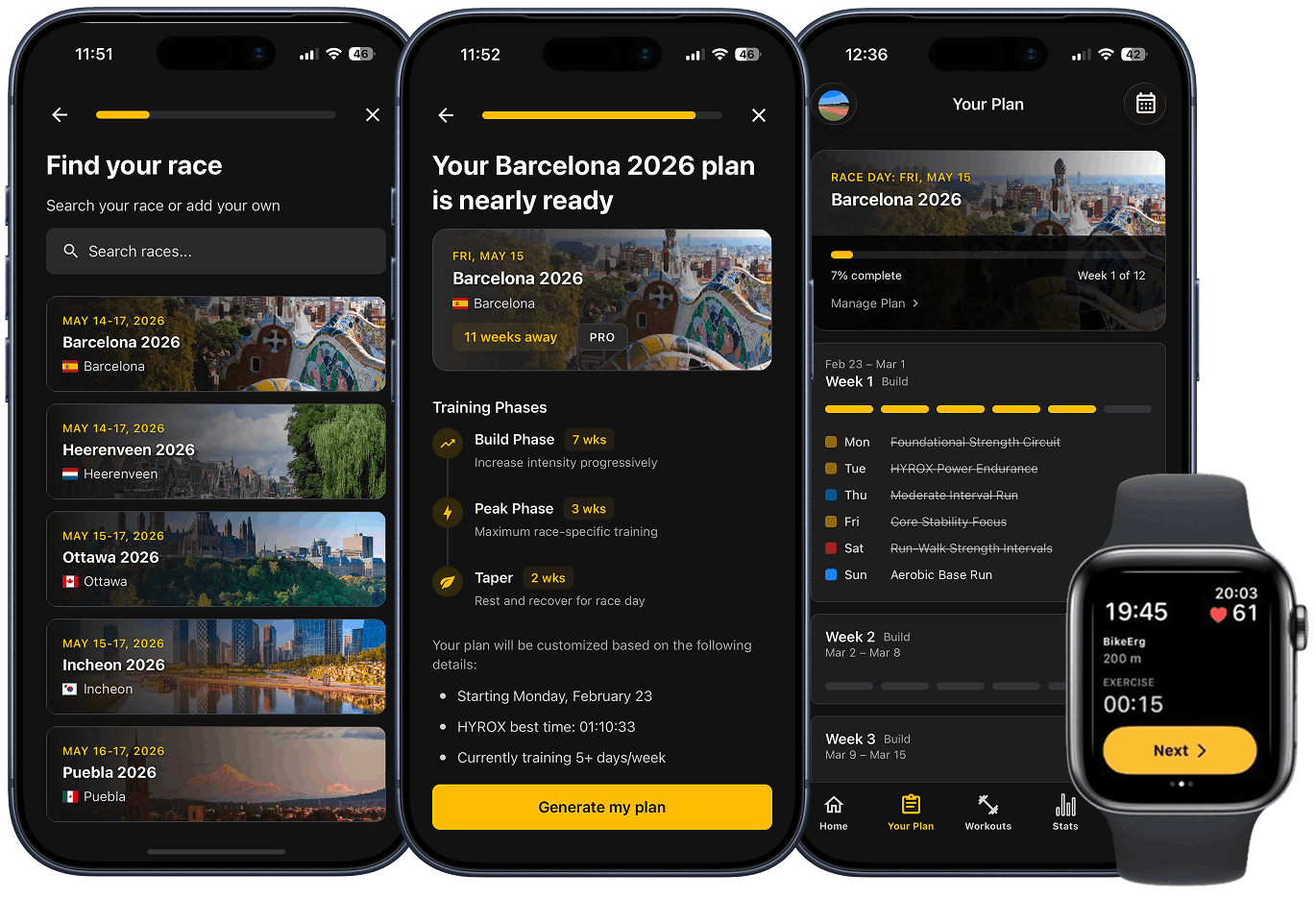
Stop guessing what to do next. TrainRox builds personalized HYROX and hybrid fitness training plans based on your fitness level and race goals.
Get daily workouts, track your progress, and arrive at the start line knowing you've done the right work.


First week free. Cancel anytime.